
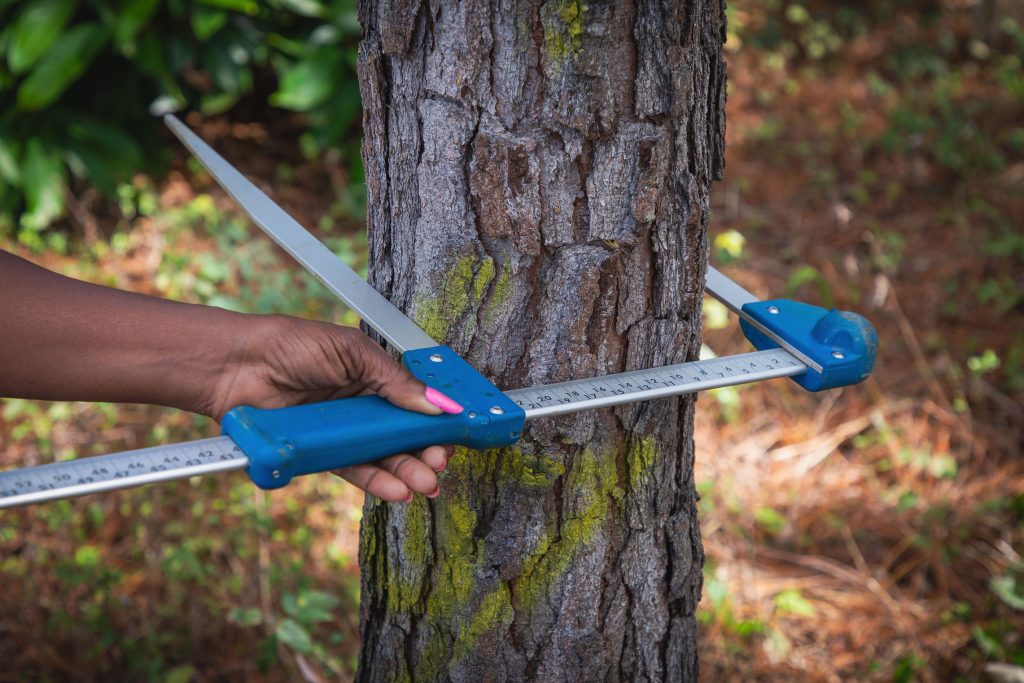
If you’re planning an extension, new build or larger development, the best time to arrange a tree survey is before your architect or designer finalises the plans.
Where trees are present on or close to a development site, a BS5837 tree survey may be required as part of the planning application. The survey identifies existing trees, assesses their condition and highlights any constraints that need to be considered when designing the development.
Many local planning authorities require this information before they can validate a planning application, so it’s worth checking the requirements before submitting your plans.
Why does the timing of a tree survey matter?
Trees can affect where buildings, driveways, access routes and foundations can be positioned.
A BS5837 tree survey identifies relevant trees and calculates their Root Protection Areas (RPAs). These are areas around trees that need to be considered when planning construction work.
For example, if a proposed extension falls within the Root Protection Area of a mature tree, the design or construction methods may need to be reconsidered.
A Tree Constraints Plan provides this information to the architect or designer, allowing tree-related restrictions to be considered while the layout is being developed.
If these constraints are identified after the plans have been completed, changes may be necessary, potentially adding time and expense to the project.
What if I’ve already submitted my planning application?
You can still arrange a BS5837 tree survey after submitting your application.
If the local planning authority identifies trees that could be affected by the development, it may request additional arboricultural information.
Where a tree survey is a validation requirement, the application may remain invalid until the necessary documents have been provided.
If the application has already been validated, the authority may still request further information during its assessment.
An arboricultural consultant can review the proposed development, survey the relevant trees and advise on the reports needed to address the authority’s requirements.
How long does a BS5837 tree survey take?
The timescale depends on the size and complexity of the site.
At Frithwood Tree Consultancy, smaller residential projects can usually be completed within a week. Larger commercial developments may take longer, particularly where there are numerous trees or more complex site conditions.
If additional information is required, such as an Arboricultural Impact Assessment, Arboricultural Method Statement or Tree Protection Plan, this should also be considered when planning your submission date.
What information do I need to arrange a tree survey?
You don’t need to have completed architectural drawings before contacting an arboricultural consultant.
To help establish what’s required, it’s useful to provide:
- The address and location of the site.
- A brief description of the proposed development.
- Any existing site plans or architectural drawings.
- Details of any requirements or correspondence from the local planning authority.
If you’re still at the early design stage, the survey can help inform the layout. If plans have already been prepared, they can be reviewed alongside the survey findings.
Arrange a BS5837 tree survey with Frithwood Tree Consultancy
Frithwood Tree Consultancy provides BS5837 tree surveys and supporting arboricultural reports for residential and commercial planning applications.
With more than 15 years of experience in arboriculture, we work with homeowners, architects, developers and planning professionals to assess trees and provide the information required for planning.
Whether you’re starting a project or have already been asked by the local planning authority for a tree survey, we can advise on what is needed.
Contact Frithwood Tree Consultancy on 07860 931420 to discuss your project.