
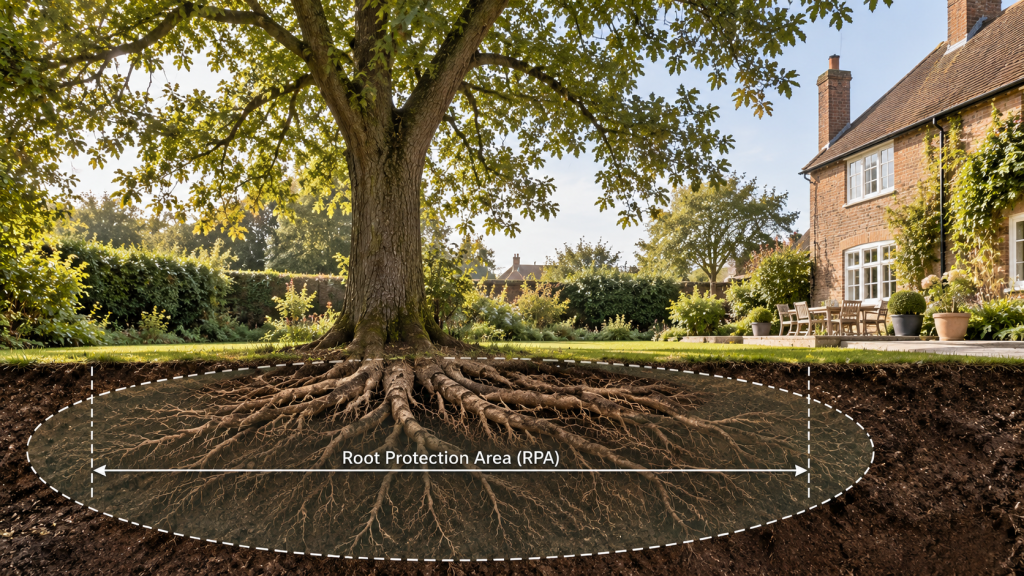
If you’re planning an extension, new build or driveway near a tree, you may come across the term Root Protection Area (RPA).
A Root Protection Area is the minimum area around a tree calculated to help protect its roots during development. Building within this area is sometimes possible, but it requires careful assessment and may involve specialist construction methods to avoid damaging the tree.
The size of the Root Protection Area is calculated using British Standard BS5837:2012, which provides recommendations for protecting trees during design, demolition and construction.
What is a Root Protection Area?
A Root Protection Area identifies the minimum area of soil around a tree considered necessary to maintain its health and stability.
Tree roots absorb water and nutrients, provide anchorage and support the tree’s growth. Construction activities such as excavation, soil compaction and changes in ground levels can damage these roots or affect the conditions they need to surviv
Although it is commonly shown as a circle around the tree on a plan, roots do not grow in a perfect circle. Their distribution depends on factors such as soil conditions, nearby structures and the availability of water.
How is a Root Protection Area calculated?
Under BS5837:2012, the Root Protection Area is generally calculated using the diameter of the tree’s trunk, measured at 1.5 metres above ground level.
For a single-stemmed tree, the standard calculation uses a radius equivalent to 12 times the trunk diameter.For example, a tree with a trunk diameter of 500 mm would have a calculated Root Protection Area radius of 6 metres.
This gives a circular area of approximately 113 square metres.
The calculation provides a starting point for assessing the space required around the tree. An arboricultural consultant may recommend an alternative shape where site conditions or existing features justify it, while maintaining the calculated area.
Multi-stemmed trees require a different calculation under BS5837.
Can I build within a Root Protection Area?
Yes, building within a Root Protection Area may be possible, depending on the tree, the site conditions and the type of construction proposed.
The Root Protection Area is an important design constraint, but it does not automatically mean that all development within it is prohibited.
An arboricultural consultant will need to assess how the proposed work could affect the tree and whether suitable measures can be used to reduce the risk of damage.
For example, a proposed driveway may be possible using a construction method designed to minimise excavation and soil compaction. Foundations close to retained trees may require an alternative design to avoid unnecessary root disturbance.
Whether these approaches are suitable will depend on the individual site and the findings of the arboricultural assessment.
What construction methods can be used near tree roots?
Where development within a Root Protection Area is considered acceptable, specialist construction methods may be recommended.
These can include:
- No-dig construction: Methods that avoid conventional excavation and minimise disturbance to existing roots, commonly considered for paths and driveways.
- Alternative foundation designs: Specialist foundations may be considered where conventional trench foundations would cause unacceptable root damage.
- Controlled excavation: Where excavation is necessary, careful methods, including hand digging or appropriate specialist equipment, may be required.
- Ground protection: Temporary protective measures can help prevent soil compaction caused by construction vehicles, machinery and site activity.
These methods are not suitable for every project. The appropriate approach will depend on the tree, the proposed work and the conditions on site.
What happens if tree roots are damaged during construction?
Damage to roots can affect a tree’s ability to absorb water and nutrients, as well as its stability. The consequences depend on the extent of the damage, the roots affected and the condition of the tree. Some effects may become apparent relatively quickly, while others can develop over several years.
Excavation is not the only concern. Heavy machinery, repeated vehicle movements and the storage of building materials can compact the soil, reducing the availability of air and water to the roots.
This is why protecting the ground around retained trees is an important part of construction planning.
Do I need permission to build within a Root Protection Area?
Building within a Root Protection Area may require supporting arboricultural information as part of a planning application.
Where trees could be affected by development, the local planning authority may request a BS5837 tree survey and Arboricultural Impact Assessment to understand the likely effects of the proposal.
An Arboricultural Method Statement and Tree Protection Plan may also be required to explain how retained trees will be protected during construction.
If a tree is protected by a Tree Preservation Order or is within a Conservation Area, additional legal considerations may apply.
An arboricultural assessment can help establish what information is needed before work begins.
How can I find out whether my proposed building work affects a Root Protection Area?
The first step is to arrange a BS5837 tree survey.
The survey records relevant information about trees on and close to the development site, including their trunk dimensions and calculated Root Protection Areas.
This information is shown on a Tree Constraints Plan, allowing the proposed development to be considered alongside the existing trees.
If the plans involve construction within a Root Protection Area, an arboricultural consultant can assess the likely impact and advise whether changes to the design or specialist construction methods should be considered.
Planning building work near trees?
Frithwood Tree Consultancy provides BS5837 tree surveys, Tree Constraints Plans, Arboricultural Impact Assessments, Arboricultural Method Statements and Tree Protection Plans for residential and commercial developments.
With more than 15 years of experience in arboriculture, we help homeowners, architects and developers understand how existing trees may affect their plans and what measures may be needed to protect them.
If you’re planning an extension, driveway or development close to trees, contact Frithwood Tree Consultancy on 07860 931420 to discuss your project.