
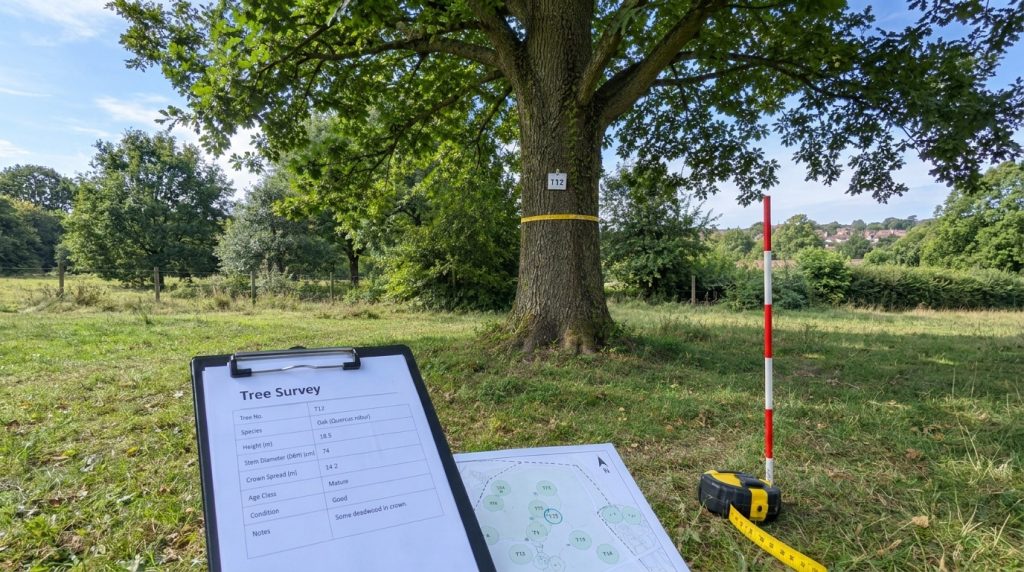
If you’re planning an extension, new build or larger development near trees, you may be asked to provide a BS5837 tree survey as part of your planning application.
A BS5837 tree survey records the species, size, condition and quality of trees on or close to a development site. It also identifies which trees may be suitable for retention and calculates their Root Protection Areas.
The findings help architects, developers and planning authorities understand how existing trees could affect a proposed development.
What information is recorded during a BS5837 tree survey?
A BS5837 survey is carried out in accordance with British Standard BS5837:2012, Trees in relation to design, demolition and construction – Recommendations.
During the site inspection, an arboricultural consultant records information about the relevant trees, including:
- Tree species: Identifying the type of tree, such as oak, beech or sycamore.
- Trunk diameter: Measuring the trunk to help calculate the Root Protection Area.
- Tree height: Recording the approximate overall height.
- Crown spread: Measuring how far the branches extend in different directions.
- Crown clearance: Recording the height of the lowest significant branches above ground level.
- Age class: Identifying whether a tree is young, semi-mature, mature or veteran.
- Physiological condition: Assessing the tree’s general health and vitality.
- Structural condition: Looking for visible defects, damage or weaknesses that may affect its suitability for retention.
- Estimated remaining contribution: Assessing how long the tree is likely to continue making a positive contribution to its surroundings.
Trees are also given individual reference numbers so they can be identified on the accompanying survey drawings.
How are trees categorised in a BS5837 survey?
BS5837 uses four categories to help identify the quality and value of trees and inform decisions about their retention.
Category A – High quality
Trees of high quality with an estimated remaining life expectancy of at least 40 years.
Category B – Moderate quality
Trees of moderate quality with an estimated remaining life expectancy of at least 20 years.
Category C – Low quality
Trees of low quality with an estimated remaining life expectancy of at least 10 years, or young trees with a stem diameter below 150 mm.
Category U – Unsuitable for retention
Trees that cannot realistically be retained as living trees in the context of the current land use for longer than 10 years.
These categories help the design team understand which trees should receive particular consideration when preparing the proposed layout.
A tree’s category does not, by itself, determine whether it can be removed. Other factors, including Tree Preservation Orders and planning requirements, may also apply.
What is included in the tree survey report?
The survey findings are presented in a report, supported by a tree schedule and relevant drawings.
The tree schedule contains the information recorded during the inspection, including measurements, condition and categorisation.
A Tree Constraints Plan shows the position of the surveyed trees, their crown spreads and calculated Root Protection Areas.
This allows the architect or designer to see where existing trees could influence the proposed layout.
Depending on the stage of the project and the local planning authority’s requirements, further documents may be needed, including an Arboricultural Impact Assessment, Arboricultural Method Statement or Tree Protection Plan.
How does a BS5837 survey help with development plans?
The survey provides information that can influence decisions about the position of buildings, foundations, driveways, access routes and other proposed features.
For example, a mature tree may have a Root Protection Area extending across part of the land intended for construction. The survey identifies this constraint so it can be considered during the design process.
The information may also help determine whether specialist construction methods or changes to the proposed layout need to be considered.
Where possible, identifying these matters before the design is finalised can reduce the need for changes later.
Are neighbouring trees included in a BS5837 survey?
Yes, where they are relevant to the proposed development.
Trees do not need to be growing within the site boundary to affect construction.
A neighbouring tree may have branches extending over the site or a Root Protection Area that overlaps the proposed development.
Relevant neighbouring trees are therefore considered as part of the assessment, although access restrictions may limit the measurements and observations that can be made.
Arrange a BS5837 tree survey with Frithwood Tree Consultancy
Frithwood Tree Consultancy provides BS5837 tree surveys and supporting arboricultural reports for residential and commercial planning applications.
With more than 15 years of experience in arboriculture, we use digital mapping software to record tree locations and prepare survey drawings tailored to each site.
Whether you’re planning a house extension, new build or larger development, we can advise on the arboricultural information required for your project.
Contact Frithwood Tree Consultancy on 07860 931420 to discuss your tree survey.